
news
In our previous episode of the Think & Move Series we explored the Switching Test and the role mental flexibility plays in everyday performance. From shifting attention to adapting strategies, that episode highlighted how cognitive switching supports real-world function—often in moments when we least expect it.
Now, in Episode 21, we turn our attention to balance and postural control, and how subtle, everyday movements can reveal important insights through the Coordinated Stability Test.
We’re Rarely Standing Still
Even when we think we’re standing still, our bodies are almost always moving. We shift our weight, adjust our stance, or lean slightly from one leg to the other. Whether speaking publicly or casually, most of us move within a preferred pattern known as a sway envelope.
The size and control of this sway envelope can offer valuable insight into postural stability and balance health. Importantly, good balance isn’t about being rigid—it’s about having the ability to move with control and intention.
Why Sway Matters in Daily Life
The ability to sway with control supports a wide range of everyday activities. From reaching into a high cabinet and pulling dishes from the dishwasher to leaning to place items away or adjusting posture during routine tasks, nearly everything we do involves subtle, controlled shifts in body weight. In these moments, balance isn’t static—it’s dynamic, constantly adapting to the movement at hand.
The demands on our ability to maintain balance vary depending on the activity. Some movements require a wider sway envelope to safely reach or lean, while others call for precise control within a smaller range. Understanding how well someone can adjust their sway to meet these demands is key to supporting mobility, safety, and independence over time.
Quantifying Movement for Functional Health
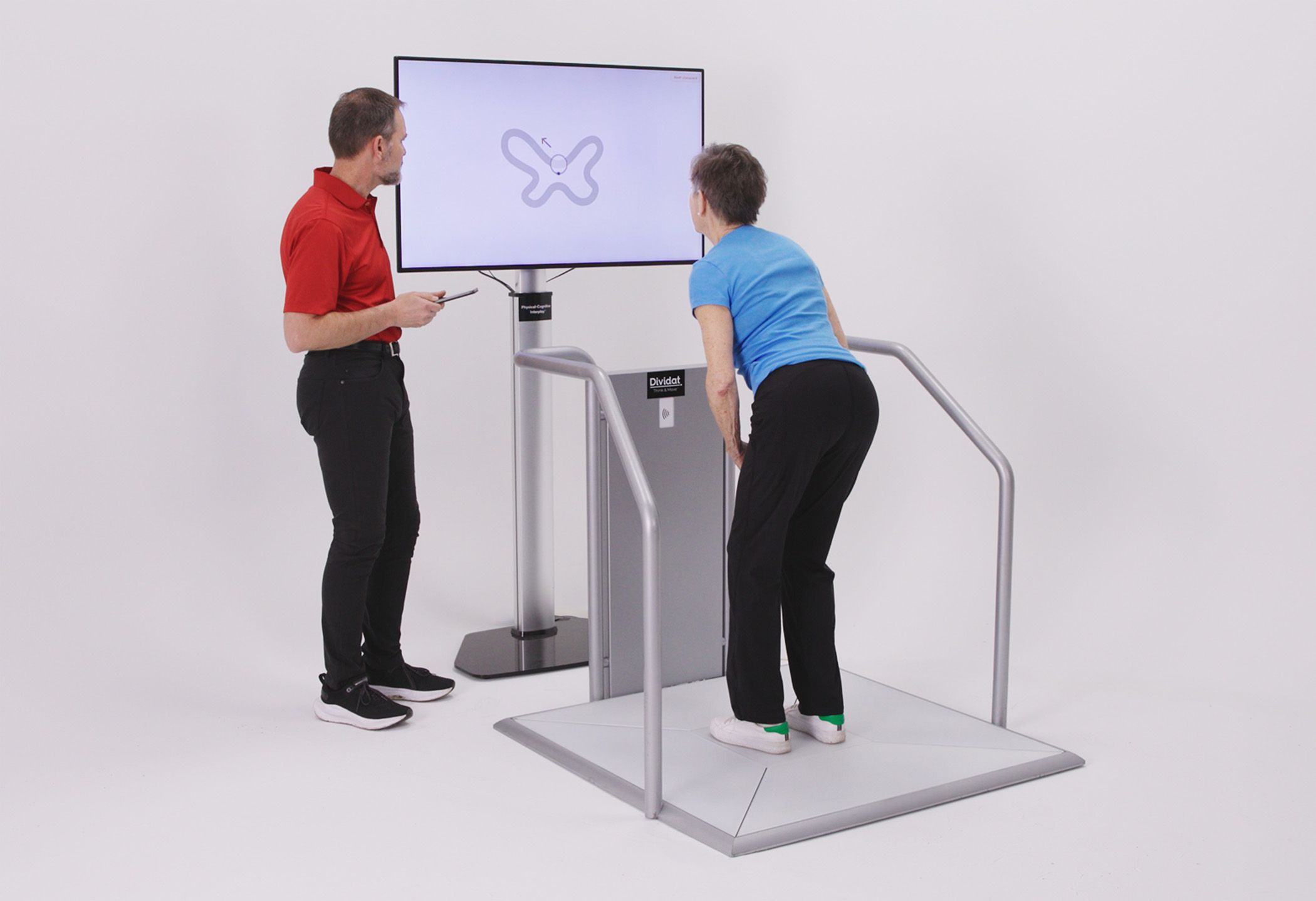
At Dividat, our goal is to quantify real-life movement so we can better understand functional health and, when appropriate, guide targeted programming to support it. The Coordinated Stability Test does just that. It evaluates a person’s ability to control the direction, size, and accuracy of their sway while responding to visual cues.
During the test, participants are asked to follow displayed movement paths by shifting their body weight. Directional arrows guide them forward onto the toes, back onto the heels, side-to-side, and through different patterns. Each task finishes by returning to a central position, reinforcing both movement and control.
Measuring Accuracy, Precision, and Control
As the test progresses, performance is continuously measured. Accuracy is tracked in milliseconds, offering insight into how precisely and efficiently someone follows the intended path. This can be challenging—especially when performing the movement while talking or processing other information.
A force platform records exactly how the body moves throughout the test. Results can then be shown both numerically and visually, clearly illustrating where movement stayed on track and where sway extended beyond the target path.
This combination of data provides meaningful feedback. Participants can see not only how they performed overall, but where control was strong and where there may be room for improvement.
Seeing Your Life in Numbers
We use balance all day long, often without thinking about it. The Coordinated Stability Test helps bring that everyday movement into focus.
By translating movement into measurable data, the assessment allows for clear comparison over time and helps identify areas that may benefit from targeted support. It connects movement quality directly to real-world function in a way that’s easy to understand and act on. The Coordinated Stability Test reminds us that balance isn’t about standing perfectly still—it’s about moving well, with control and purpose. And when those movements can be clearly measured, they offer powerful insight into functional health and long-term wellbeing.
Ready to see the Dividat Senso Neuro Gym in action?
Schedule a personalized demo to explore how real-time cognitive and physical data can support assessment, training, and everyday performance.